Where RAG Fails: A Deep Dive Into the Real Limitations of Retrieval-Augmented Generation
Where RAG Fails: A Deep Dive Into the Real Limitations of Retrieval-Augmented Generation
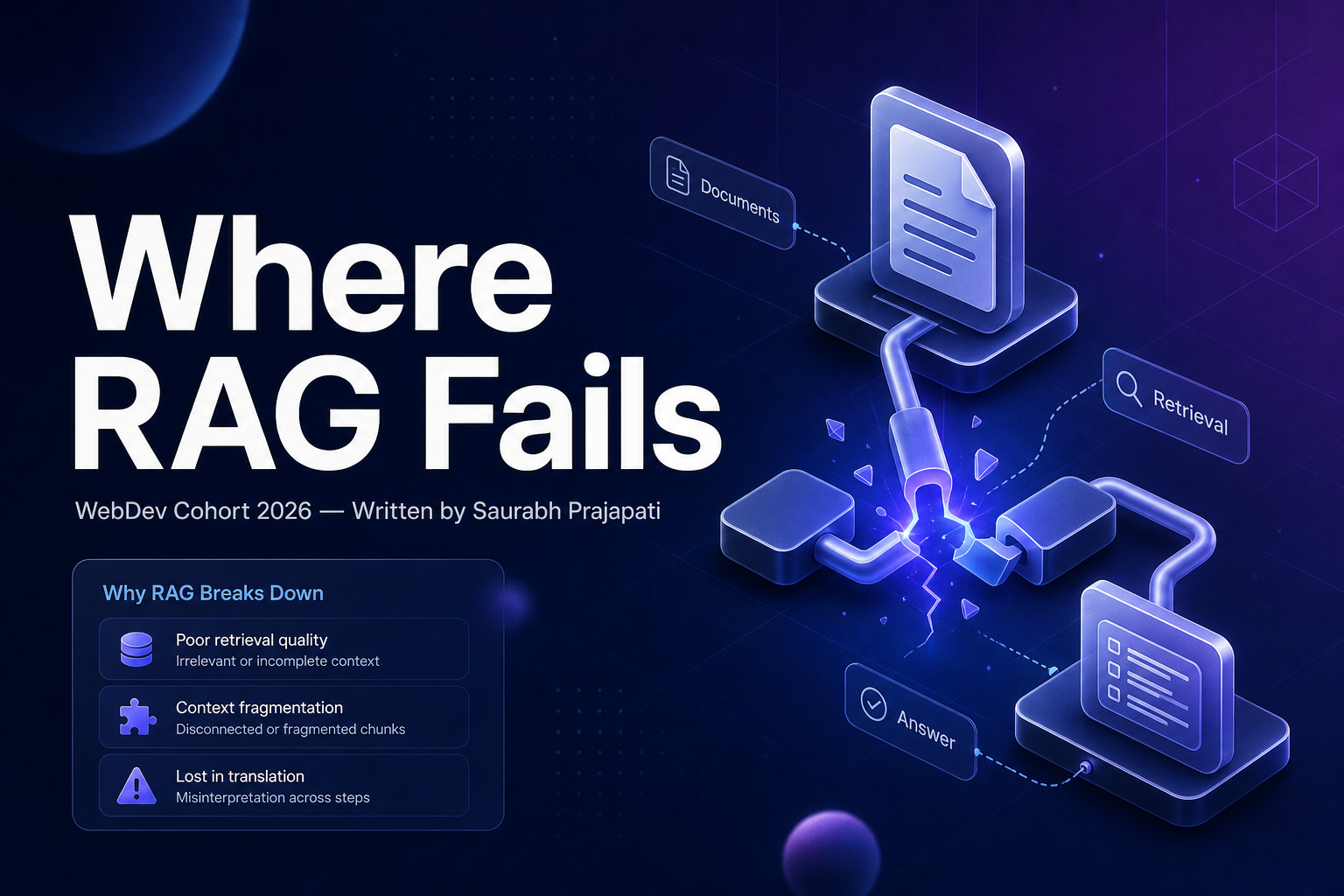
TL;DR: RAG improves LLM responses by injecting retrieved knowledge at inference time, but it doesn't guarantee correctness. Poor chunking, weak retrieval, context window limits, and stale knowledge bases can all silently degrade output quality. This article explains every major failure mode and when to reconsider RAG entirely.
Introduction
Large language models are impressive until they're not. Ask a GPT-4-class model about a proprietary internal policy document, last week's API changelog, or a niche compliance regulation, and you'll get one of three outcomes: a confident hallucination, an honest "I don't know," or — if you're lucky — a hedge that pushes you to verify elsewhere.
The community's answer to this problem was Retrieval-Augmented Generation (RAG). The idea is straightforward: before the model generates a response, fetch relevant documents from an external knowledge source and stuff them into the prompt. Now the model has actual evidence to work with instead of relying solely on what it absorbed during training.
RAG works. Teams have shipped real products with it, reduced hallucination rates measurably, and enabled LLMs to answer questions about data that changes daily. But the pattern has rough edges that aren't always visible until a system is in production and users are filing bug reports.
This article is for developers, ML engineers, and technical architects who are evaluating or already operating a RAG pipeline. We'll assume you understand what embeddings and vector databases are at a conceptual level, but we'll keep the focus on ideas rather than implementation specifics. By the end, you'll have a clear map of every place a RAG pipeline can break — and what to do about it.
Background: Why LLMs Need External Knowledge
Every LLM is trained on a snapshot of text from the internet, books, and other corpora — frozen at a specific point in time. This creates two structural problems:
- Knowledge cutoff: The model knows nothing about events, documents, or data that postdates its training.
- No private knowledge: Your internal wiki, your customer database, your proprietary research — none of it exists inside the model.
Beyond those two, there's a subtler problem: even when the model does know a fact, it may not retrieve it reliably under all phrasings of a question. Training doesn't guarantee perfect recall.
The naive solution is fine-tuning: train the model further on your proprietary data. But fine-tuning is expensive, slow to update, and doesn't eliminate hallucinations — it just shifts their distribution. A model fine-tuned on outdated policy documents will confidently recite outdated policy.
RAG offers a cheaper, more flexible alternative: keep the base model frozen, and supply relevant information dynamically at query time.
How a Basic RAG Pipeline Works
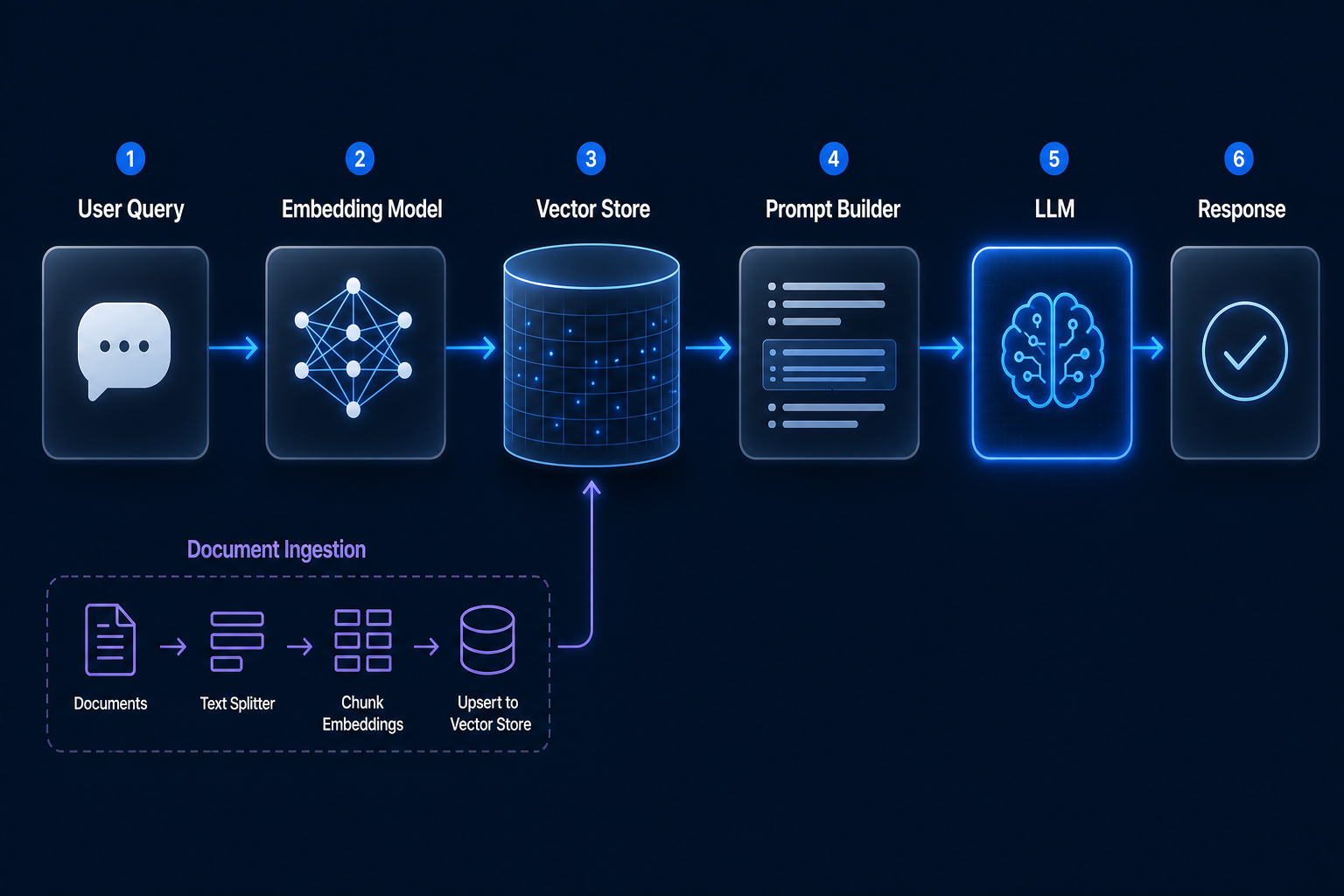
The pipeline has five conceptual stages:
flowchart LR
    A([User Query]) --> B[Embedding Model]
    B --> C[(Vector Store)]
    C -->|Top-K Chunks| D[Prompt Builder]
    A --> D
    D --> E[LLM]
    E --> F([Response])
- Ingestion: Documents are split into chunks, each chunk is converted to a vector embedding, and the vectors are stored in a vector database (Pinecone, Weaviate, pgvector, etc.).
- Query embedding: The user's question is embedded using the same model.
- Retrieval: The vector store returns the top-K chunks most semantically similar to the query.
- Prompt construction: Retrieved chunks are prepended to the prompt as context.
- Generation: The LLM reads the augmented prompt and generates a grounded response.
Here's a simplified but realistic Python example of an ingestion and retrieval step:
from sentence_transformers import SentenceTransformer
import numpy as np
from sklearn.metrics.pairwise import cosine_similarity

# Step 1: Embed a small document corpus
embedder = SentenceTransformer("all-MiniLM-L6-v2")

documents = [
    "Refund requests must be submitted within 30 days of purchase.",
    "Premium subscribers receive priority support with a 4-hour SLA.",
    "To reset your password, visit the account settings page.",
    "The API rate limit is 1000 requests per minute per tenant.",
    "Orders placed before 3 PM EST ship the same business day.",
]

doc_embeddings = embedder.encode(documents)  # shape: (5, 384)

# Step 2: Embed the user query
query = "What is the deadline for requesting a refund?"
query_embedding = embedder.encode([query])   # shape: (1, 384)

# Step 3: Find the top-2 most similar chunks
similarities = cosine_similarity(query_embedding, doc_embeddings)[0]
top_indices = np.argsort(similarities)[::-1][:2]

print("Retrieved chunks:")
for i in top_indices:
    print(f"  [{similarities[i]:.3f}] {documents[i]}")
Expected output:
Retrieved chunks:
  [0.812] Refund requests must be submitted within 30 days of purchase.
  [0.431] Orders placed before 3 PM EST ship the same business day.
The first result is highly relevant. The second is noise. That ratio — useful signal mixed with tangential content — is the source of most RAG failure modes.
Common Scenarios Where RAG Works Well
Before drilling into failures, it's worth being fair about where RAG genuinely shines:
- Customer support over a static knowledge base: FAQs, return policies, and troubleshooting guides that change infrequently map cleanly to chunks.
- Internal documentation Q&A: Engineers querying a company wiki or architecture decision records.
- Legal and compliance research: Surfacing relevant clauses from a known document set where the source of truth is stable.
- Long-document summarization with attribution: When users need to trace answers back to specific passages.
In these scenarios, the documents are authoritative, relatively stable, and the queries are focused enough that retrieval is likely to succeed. The danger comes when teams assume these properties hold universally — and then deploy RAG into messier real-world conditions.
Where RAG Actually Fails
1. Poor Retrieval: The System Finds the Wrong Documents
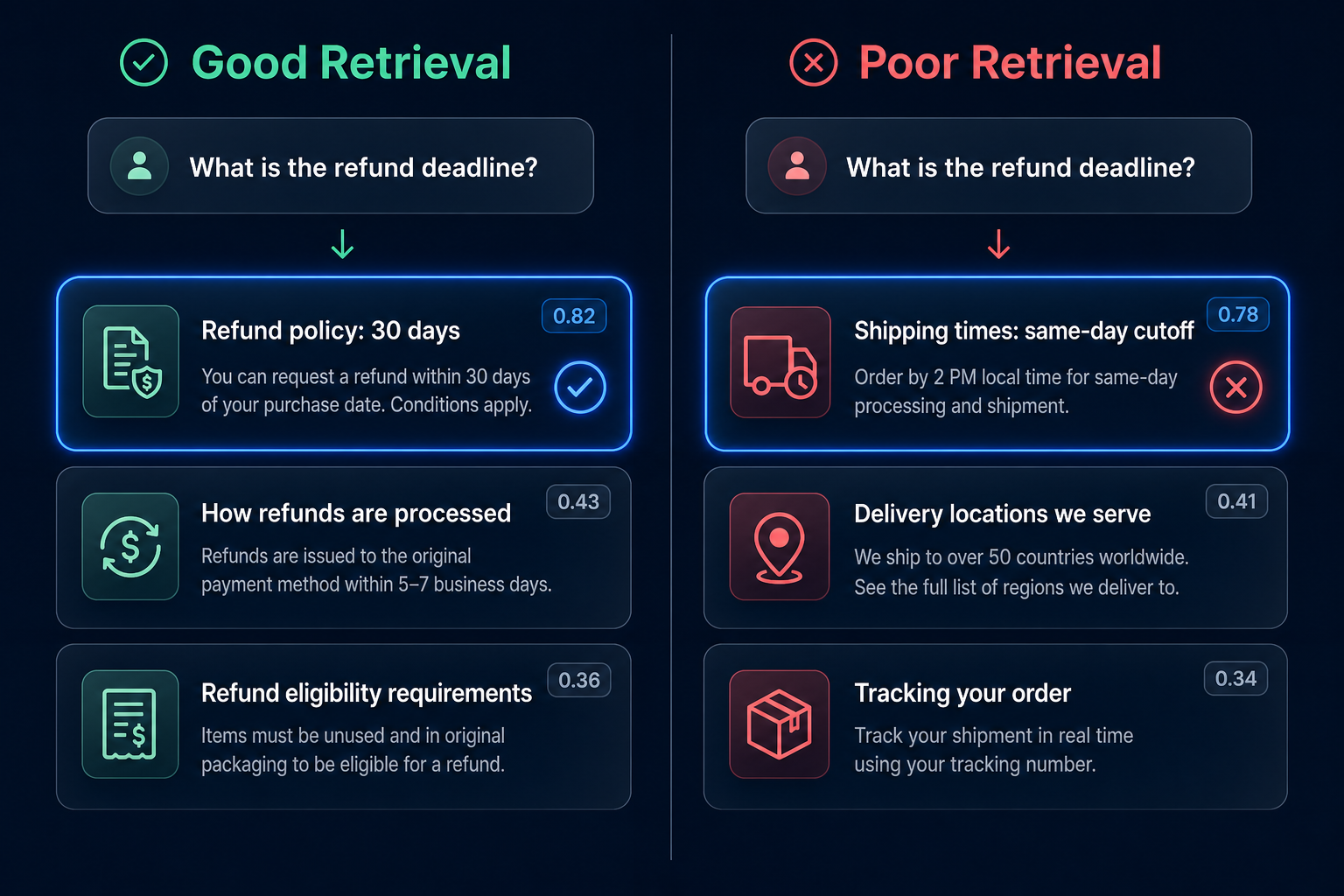
Retrieval is the foundation. If the wrong chunks come back, the LLM works with bad inputs, and no amount of model quality saves you.
Retrieval fails in several well-understood ways:
Semantic mismatch: Embedding models compress meaning into a fixed-size vector. Queries phrased differently from how the document was written can produce low cosine similarity even when the content is directly relevant.
Example: A user asks "Can I get my money back?" but your policy document says "Refund eligibility criteria." Depending on the embedding model, these may not land close in vector space.
Vocabulary gap: Domain-specific jargon (medical, legal, financial) is often underrepresented in general-purpose embedding model training data. A query using lay terms may not retrieve a chunk full of technical terminology, even if they describe the same concept.
Top-K cutoff: Retrieval systems return a fixed number of chunks. If the relevant information is ranked 6th and you only retrieve 5, you miss it. Increasing K helps — until the next problem hits.
2. Poor Chunking: Breaking Documents in the Wrong Places
Chunking is arguably the most underappreciated step in a RAG pipeline. Documents need to be split before embedding, and the strategy used here directly determines whether meaning survives the split.
Fixed-size chunking (splitting every N characters or tokens) is the most common approach — and often the worst. It can cut a sentence mid-thought, separate a heading from the content it describes, or split a table from the paragraph that explains it.
# Naive fixed-size chunking — illustrates the problem
text = """
Section 4.2: Termination Policy
An employee may be terminated without cause with 2 weeks notice.
Termination with cause requires documentation of at least 3 performance
warnings issued within a 6-month period. Appeals must be submitted within
10 business days of the termination notice.
"""

chunk_size = 80  # characters
chunks = [text[i:i+chunk_size] for i in range(0, len(text), chunk_size)]

for idx, chunk in enumerate(chunks):
    print(f"Chunk {idx}: {repr(chunk)}")
Output (truncated):
Chunk 0: '\nSection 4.2: Termination Policy\nAn employee may be terminated wi'
Chunk 1: 'thout cause with 2 weeks notice.\nTermination with cause requires doc'
Chunk 2: 'umentation of at least 3 performance\nwarnings issued within a 6-mont'
Chunk 3: 'h period. Appeals must be submitted within\n10 business days of the t'
Chunk 4: 'ermination notice.\n'
Chunk 1 starts with "thout cause" — a fragment with no standalone meaning. If this chunk is retrieved, the LLM has to guess the missing prefix. That's a compounding error.
Better chunking strategies — splitting on paragraph boundaries, sentence boundaries, or using recursive character splitting with overlap — preserve semantic units. But they're not default, and they still don't eliminate the problem in tables, code blocks, or cross-reference-heavy legal documents.
Warning: There is no universally correct chunk size. Small chunks (128 tokens) preserve precision but lose context. Large chunks (1024 tokens) preserve context but dilute relevance signals and consume context window budget faster. Always tune chunk size for your specific document type and query distribution.
3. Context Window Limitations
Every LLM has a finite context window — the number of tokens it can process in a single forward pass. GPT-4-turbo supports 128K tokens; many open-source models top out at 4K–8K. This creates a hard ceiling on how much retrieved content you can inject.
The math is unforgiving:
| Component | Approximate Token Budget |
|---|---|
| System prompt | 200–500 tokens |
| Conversation history | 500–2000 tokens |
| Retrieved chunks (5 × 512) | 2560 tokens |
| User query | 50–200 tokens |
| Generation headroom | 500–1000 tokens |
| Total | ~5000–6000 tokens |
For a model with an 8K context, you're already constrained. For a model with a 4K context, you can only retrieve 2–3 chunks before you're out of room.
The deeper problem is that even models with large context windows exhibit what researchers call "lost in the middle" behavior: relevant information placed in the middle of a long context is less likely to be referenced than information at the beginning or end. So more context isn't always better — it can actually reduce answer quality if the relevant passage gets buried.
4. Hallucinations Persist Even With RAG
This is the hardest pill to swallow: RAG reduces hallucinations, it does not eliminate them.
Several mechanisms keep hallucinations alive:
The retrieved chunk doesn't fully answer the question. The LLM recognizes a gap and fills it with a plausible-sounding fabrication rather than admitting uncertainty. This is especially common when questions have multiple parts and only one part is covered by retrieved context.
The model over-relies on parametric memory. If the LLM's training data strongly associates a query with a particular answer, it may blend that memorized answer with retrieved content — producing a hybrid that's partly real, partly invented.
Conflicting information in the context. If two retrieved chunks contradict each other (common in documents that have been updated over time without deduplication), the LLM must arbitrate. It often does so silently, picking one without flagging the conflict.
# Illustrating the conflict scenario
context_chunks = [
    # From an outdated policy page
    "Premium support SLA is 8 hours for all ticket priorities.",
    # From an updated policy page added 3 months later
    "As of Q3 2024, Premium SLA is 4 hours for P1 and 8 hours for P2/P3.",
]

query = "What is the SLA for a Premium P1 ticket?"

# An LLM given both chunks might answer "4 hours" (correct),
# "8 hours" (outdated), or blend them: "4-8 hours depending on the plan"
# — which is not stated in either chunk. All three are plausible outputs.
print("Conflicting context. LLM response is non-deterministic.")
The fix — deduplicating and versioning your knowledge base aggressively — is operational, not algorithmic. The model itself has no way to resolve the conflict correctly without explicit metadata about document recency.
5. Stale Knowledge Bases
RAG decouples the LLM from the knowledge source, which is great for updates — in theory. In practice, keeping the vector store synchronized with the source of truth is a continuous engineering problem that teams underestimate.
Consider a company that ingests its help center articles into a vector database. When an article is updated:
- The old chunk must be deleted
- The new chunk must be embedded and inserted
- Any chunks that were split differently in the new version must be reconciled
If the ingestion pipeline runs nightly and a critical policy changes at 9 AM, your RAG system gives wrong answers for up to 23 hours. In regulated industries, that's not acceptable.
Note: Stale retrieval is often harder to detect than hallucination because the answer looks correct — it was correct, just not anymore. Monitoring for knowledge base freshness requires explicit tooling separate from your LLM evaluation loop.
6. Multi-Hop Questions Require Reasoning Across Chunks
Some questions can't be answered from a single document passage. They require combining information from multiple locations — what researchers call multi-hop reasoning.
Example: "Is the support SLA different for customers on the Enterprise plan who are also in the EU data region?"
Answering this correctly requires:
- Retrieving the SLA definitions (Chunk A)
- Retrieving the Enterprise plan feature set (Chunk B)
- Retrieving the EU data region policy (Chunk C)
- Synthesizing all three correctly
Standard dense retrieval has no mechanism to request these three chunks together. It retrieves each independently based on query similarity, and the result is that Chunks A and B might be retrieved while Chunk C — which is semantically distant from the query but logically required — gets missed entirely.
This failure mode is particularly painful because it's invisible at retrieval time. The retrieval step reports success (it found relevant-looking chunks), but the synthesis step silently fails.
When RAG Is Not the Right Solution
RAG is a tool, not a universal answer. Here's an honest breakdown of when to reconsider:
| Scenario | Better Alternative |
|---|---|
| Data changes in real-time (stock prices, live inventory) | Direct API calls at inference time ("tool use") |
| The knowledge domain requires precise numerical computation | Code interpreter / calculator tools |
| You need guaranteed recall of every fact in a document set | Traditional search (BM25, Elasticsearch) with manual verification |
| The question requires cross-document reasoning over hundreds of documents | Graph-based retrieval or structured knowledge bases |
| Your document set is tiny (<50 pages) | Just stuff it all in the context window (no retrieval needed) |
| Privacy-sensitive data that cannot leave your network | Local LLMs with fine-tuning, not vector databases on cloud infra |
Tip: Before building a RAG pipeline, ask: "Could I solve this with a good search engine and a human reading the results?" If yes, that might be the right prototype to start with. RAG is useful when you need the synthesis step — not just the retrieval step.
Trade-offs & Pitfalls at a Glance
| Failure Mode | Severity | Detection Difficulty | Common Mitigation |
|---|---|---|---|
| Wrong chunks retrieved | High | Medium | Hybrid retrieval (dense + BM25) |
| Chunk boundary cuts meaning | Medium | Hard | Semantic / sentence-aware chunking |
| Context window overflow | High | Easy | Chunk compression, re-ranking |
| Hallucination on gaps | High | Hard | Confidence scoring, citations |
| Stale knowledge base | Medium–High | Hard | Incremental sync pipelines |
| Conflicting chunks | Medium | Hard | Document versioning + dedup |
| Multi-hop reasoning failure | High | Very Hard | Graph RAG, iterative retrieval |
Best Practices
These aren't aspirational suggestions — they're the minimum viable mitigations for a production RAG system:
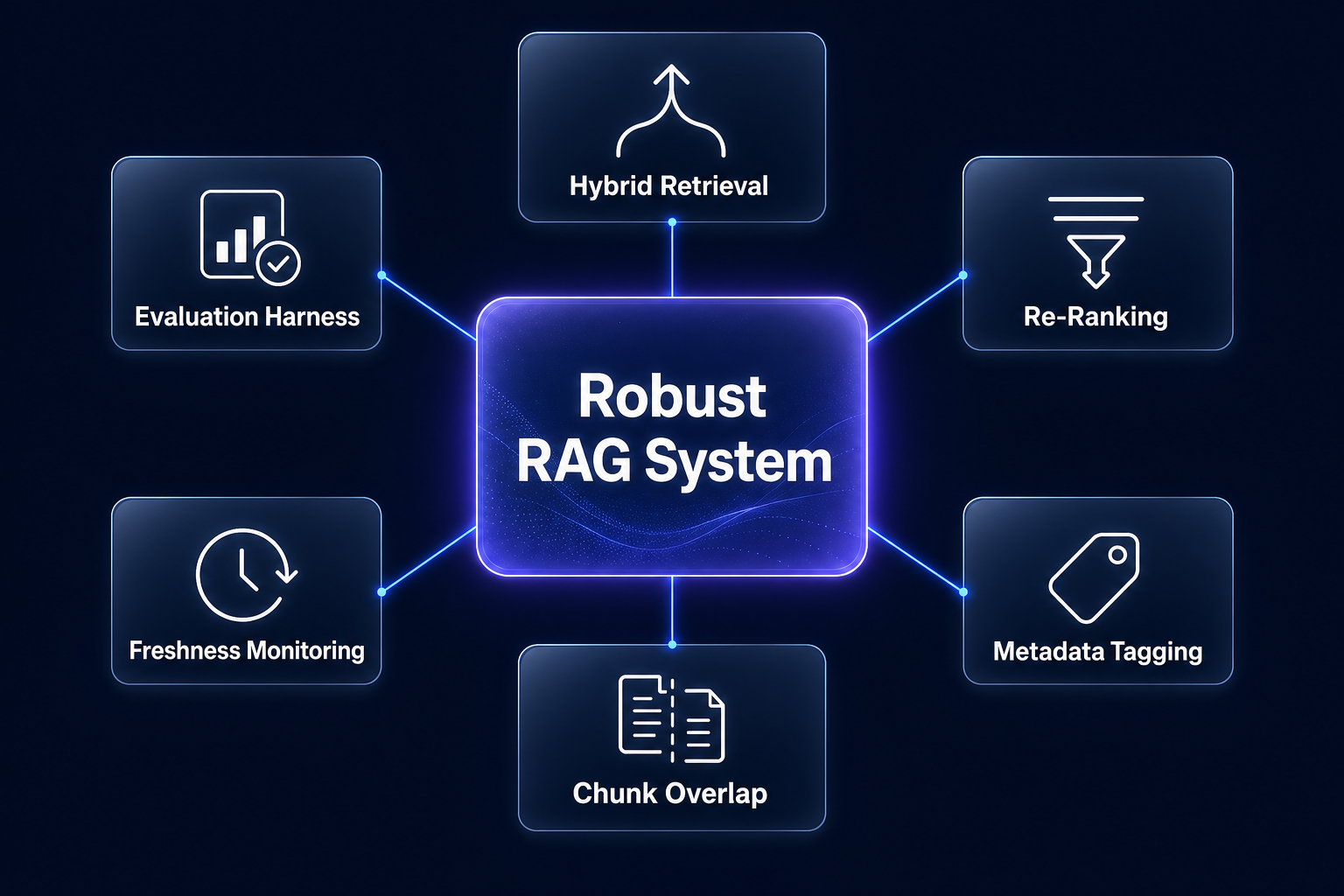
Use hybrid retrieval. Combine dense vector search with BM25 keyword matching. Reciprocal Rank Fusion (RRF) merges the result lists. This dramatically reduces the vocabulary gap problem.
Add a re-ranker. After retrieving top-20 candidates, run a cross-encoder re-ranker (e.g.,
cross-encoder/ms-marco-MiniLM-L-6-v2) to pick the best 4–5. Cross-encoders see both query and document together, giving far better precision than embedding similarity alone.Chunk with overlap and semantic awareness. Use a recursive text splitter with 10–15% overlap between adjacent chunks so boundary-spanning information isn't lost. Split on paragraph and sentence boundaries before falling back to character count.
Add metadata to every chunk. Store the source URL, document title, last-modified timestamp, and section heading alongside each chunk. Use this metadata to filter retrieval (e.g., "only consider documents updated in the last 30 days") and to generate citations in responses.
Build an evaluation harness before you optimize. Without a ground-truth QA dataset and measurable retrieval precision/recall, you're tuning blind. Tools like RAGAS and TruLens exist specifically for this.
Prompt the model to cite sources and express uncertainty. Instructing the LLM to say "Based on the provided document..." and "I don't have enough information to answer..." doesn't eliminate hallucination but it makes failures more detectable by users.
Monitor knowledge base freshness as a first-class metric. Track the age distribution of your document corpus. Alert when critical document categories haven't been updated in a threshold period.
Conclusion
RAG is a genuine improvement over naked LLM inference for knowledge-intensive tasks. It reduces hallucination rates, enables use of private and recent data, and provides a path to citations and verifiability. These are real, meaningful benefits.
But the pattern carries a mental model trap: because retrieval looks like evidence, teams treat RAG outputs as more reliable than they are. The retrieval step can fail silently. The chunking step can destroy semantic coherence invisibly. The context window can truncate critical information without warning. And hallucinations can survive all of it.
The engineers who get the most out of RAG are the ones who treat it as a system with multiple independently-failing components — not a plug-and-play correctness guarantee. Build your evaluation infrastructure first. Measure retrieval quality separately from generation quality. Know your failure modes before your users find them.
Key takeaways:
- RAG grounds LLM outputs in external documents but does not guarantee correctness.
- Retrieval quality is the foundation — a well-tuned retriever often matters more than model choice.
- Chunking strategy directly determines whether meaning survives into the context window.
- Hallucinations persist when retrieved context has gaps, conflicts, or is simply wrong.
- Stale knowledge bases produce confident, outdated answers that are harder to catch than outright hallucinations.
- Some problem shapes — real-time data, multi-hop reasoning, guaranteed recall — require architectures beyond standard RAG.
Your next step: if you have a RAG system in production, build a retrieval evaluation set of 50–100 representative questions, measure Precision@K and Recall@K, and identify which failure modes dominate. That data will tell you exactly where to invest next.
Further Reading
- RAGAS: Evaluation Framework for RAG Pipelines — automated metrics for context precision, recall, faithfulness, and answer relevance.
- LangChain RAG Tutorials — practical implementation patterns with multiple retrieval strategies.
- Lost in the Middle: How Language Models Use Long Contexts — the research paper demonstrating positional bias in long-context LLMs.
- Pinecone Learning Center: Chunking Strategies — comprehensive coverage of chunking trade-offs with benchmarks.
- Graph RAG (Microsoft Research) — an approach to multi-hop reasoning limitations using knowledge graphs.